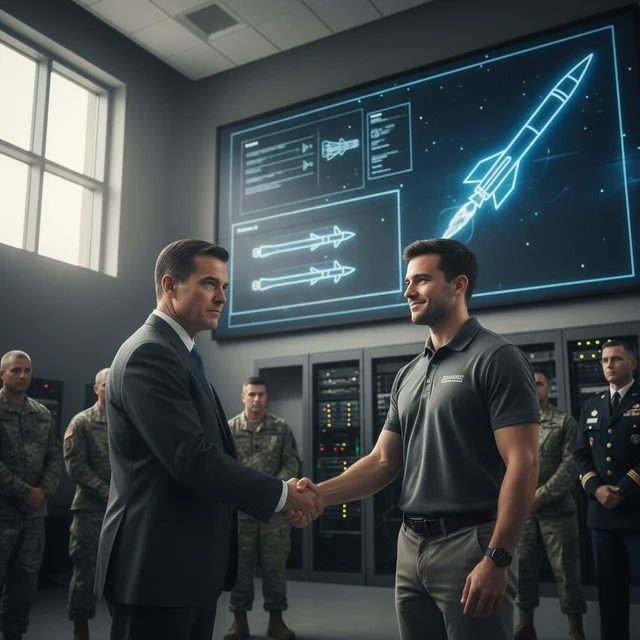
The Pentagon has announced framework agreements with Anduril, CoAspire, Leidos, and Zone 5 to launch the Low-Cost Containerized Missiles (LCCM) program, marking a major shift in US military procurement toward commercial innovation.
The announcement came on the same day Anduril raised $5 billion in funding, doubling its valuation to $61 billion.
What is the LCCM Program?
The LCCM program aims to rapidly field effective and affordable kinetic mass for the Joint Force at scale. It directly implements President Trump and Secretary Heget’s mandate to strengthen America’s military with what they’re calling the “Arsenal of Freedom.”
Key Objectives:
- Fast-paced experimentation and assessment
- Rapid production of high-volume strike capabilities
- Establishment of clear demand signals for industry
Anduril’s Role and Valuation
Funding Details:
| Metric | Value |
|---|---|
| Latest Funding | $5 billion |
| Valuation | $61 billion |
| Lead Investors | Thrive Capital, Andreessen Horowitz |
| CEO | Palmer Luckey |
Anduril, founded by Oculus creator Palmer Luckey, has quickly become one of the most valuable defense technology companies in the world.
Procurement Targets
The Department of War plans to procure over 10,000 low-cost cruise missiles across these portfolios in just three years, starting in 2027.
Missile Programs:
| Program | Vendor | Procurement Target | Timeline |
|---|---|---|---|
| LCCM | Anduril, CoAspire, Leidos, Zone 5 | 10,000+ missiles | 2027-2029 |
| Blackbeard | Castelion | 500/year, up to 12,000 total | 5 years |
Castelion Contract:
- Two-year multi-year procurement
- Minimum 500 Blackbeard missiles annually
- Options to extend up to five years
- Goal: Over 12,000 missiles over five years
New Commercial Partnership Model
Defense Secretary Michael Duffey highlighted the significance of this approach:
“We are moving beyond the traditional prime contractors to expand our industrial base, accelerating testing timelines, and sending a clear, long-term demand signal to innovative new entrants.”
Traditional vs New Model:
| Aspect | Traditional | New Commercial Model |
|---|---|---|
| Timeline | 10-15 years | Speed of commercial industry |
| Investment | Government-funded | Private sector capital |
| Vendors | Prime contractors | Startups and innovators |
| Production | Low volume | High volume, scalable |
Timeline and Next Steps
Immediate Actions (June 2026):
- Department will procure test missiles from all four LCCM companies
- Begins groundwork for assessment phase
Experimentation Lead:
- Office of the Under Secretary of War for Research and Engineering
- Army Program Acquisition Executive Fires (transition partner)
Key Quotes
Emil Michael, Under Secretary of War for Research and Engineering:
“We will deliver affordable mass for our warfighters at unprecedented speed. These Framework Agreements commit American industry to on-time, on-cost delivery and investment in R&D and facilities.”
Michael Duffey, Under Secretary of War for Acquisition and Sustainment:
“Today’s announcement is the latest sign that our Acquisition Transformation Strategy is delivering on its promise to rebuild the Arsenal of Freedom.”
Implications for Defense Industry
This partnership model signals a major shift in how the US military procures weapons:
Benefits:
- ✅ Faster development cycles
- ✅ Lower costs through competition
- ✅ Access to cutting-edge commercial technology
- ✅ Private investment reducing taxpayer burden
Challenges:
- ❌ Quality control with new vendors
- ❌ Security concerns with startups
- ❌ Dependency on private capital markets
- ❌ Potential supply chain risks
Major Defense Tech Players
| Company | CEO | Valuation | Focus |
|---|---|---|---|
| Anduril | Palmer Luckey | $61B | AI, drones, missiles |
| Palantir | Alex Karp | $50B+ | Data analytics |
| SpaceX | Elon Musk | Private | Rockets, satellites |
| Shield AI | Nathan Schuessel | $2.7B | Autonomous drones |
Key Takeaways
- Pentagon partners with Anduril and 3 startups for LCCM program
- Anduril raises $5B, valued at $61 billion
- Plan to procure 10,000+ missiles by 2029
- New commercial partnership model rewards speed and innovation
- Test missiles procurement begins June 2026
- Part of “Acquisition Transformation Strategy”
This represents the most significant shift in US military procurement in decades, moving from traditional defense contractors toward agile commercial innovators.